


UKHRUL: The call to rejuvenate the Tangkhul Naga Hills is increasingly being framed not merely as a development agenda, but as a collective responsibility requiring changes in governance, education, social values, environmental protection and community participation.
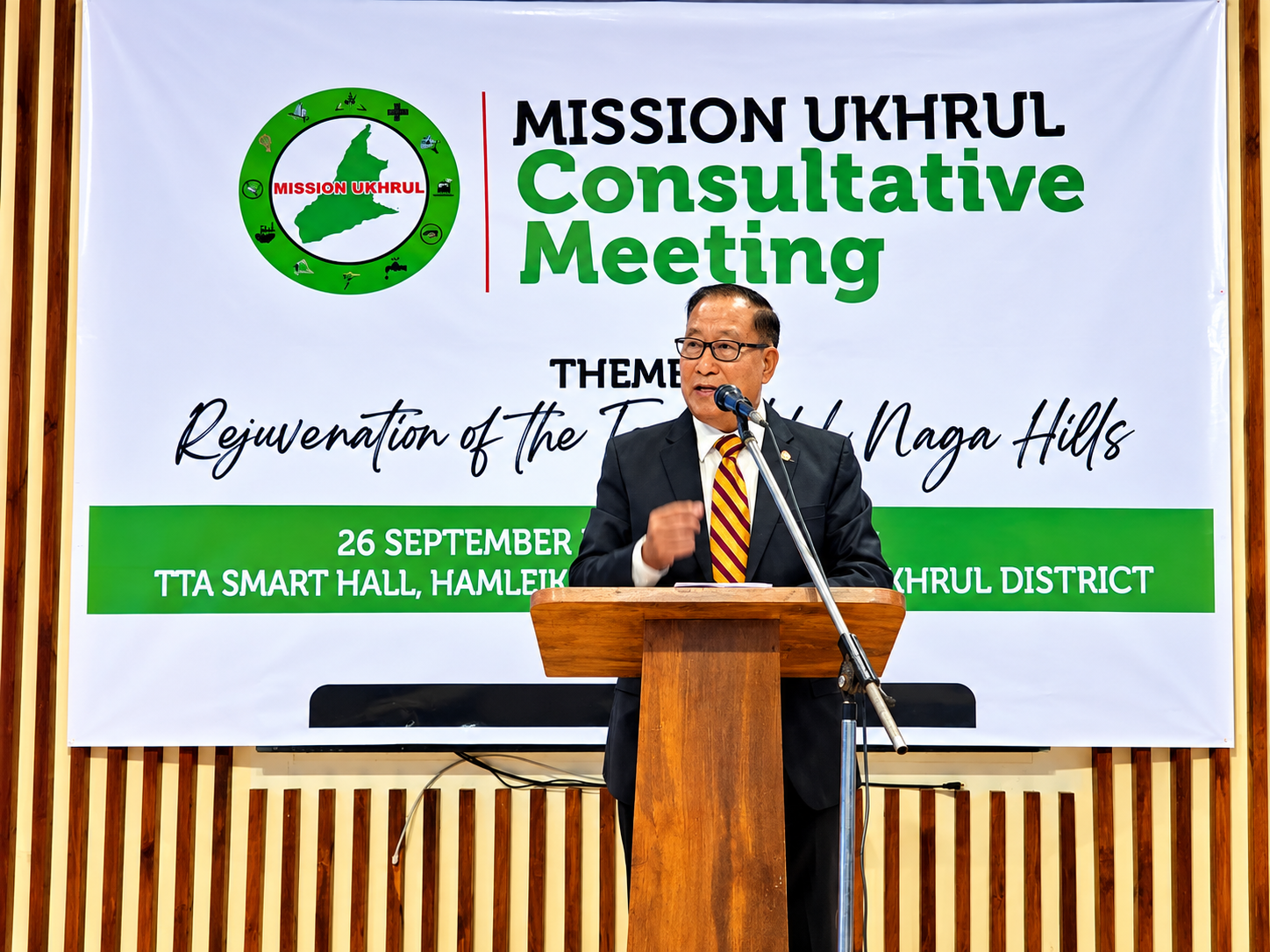
This emerged strongly at a “Mission Ukhrul” consultative meeting convened by Ukhrul MLA Ram Muivah on Saturday at the TTA Smart Hall, Hamleikhong, Ukhrul town, under the theme “Rejuvenation of the Tangkhul Naga Hills.”
Bringing together representatives from education, civil society, religious institutions, government agencies and other sections of society, the meeting provided a platform for participants to identify challenges facing the region and suggest ways forward.
Addressing the gathering, MLA Ram Muivah said the consultation was intended to gather public suggestions and contributions towards revitalising the Tangkhul region. He acknowledged that several shortcomings remained across different sectors and said the ideas emerging from the consultation would be considered in efforts to address them.
Rather than limiting rejuvenation to infrastructure and economic development, speakers at the meeting placed considerable emphasis on the need to strengthen the foundations of society.
Education was highlighted as one of the most important areas requiring attention. Pettigrew College principal Dr Rinkahao Horam said meaningful transformation would remain difficult without proper education. He stressed that education plays a central role in rebuilding society and called for greater attention to sectors including politics, handicrafts and other areas of local development.
The discussion also turned towards governance and social institutions. Tangkhul Shanao Long president LW Thingreiphi called for introspection into existing systems of governance, including customary, governmental and church institutions. She said structural changes were necessary to meet contemporary challenges and identified corruption as one of the factors affecting development.
She also emphasised the need to strengthen the participation of women in customary institutions and church ministry, suggesting that wider inclusion would be important for social progress.
For retired lecturer Makrev Hongray, spiritual and social unity must remain an important component of the region’s development. He called upon Tangkhuls to embrace unity despite denominational differences and encouraged the younger generation to remain connected to their community and identity.
The issue of cultural identity was also raised during the consultation. Former NPF Division (Women Wing) president YS Thotreivon Kapai stressed that social transformation begins within families and communities. She encouraged people to value their roots and traditional attire rather than simply adopting outside cultural influences.
Economic development and entrepreneurship also formed part of the discussion. MSME DFO Imphal YP Kashing Shingnaisui highlighted the importance of individual civic and social responsibility and urged citizens to make use of government schemes aimed at promoting entrepreneurship.
She said development could not depend solely on institutions or political leadership, stressing that individual contributions and selfless service were equally important to the growth of society.
The environment emerged as another major concern. NPF Division Ukhrul general secretary Dr Ranreiphi Kharei called for greater ecological protection and pointed to the close relationship between the community’s identity, traditional knowledge and the natural landscape.
She stressed that traditional knowledge and modern scientific understanding should complement one another in addressing contemporary challenges. She also called for greater opportunities and space for young people, noting that youth should not be viewed only as the future but as active participants in the present.
The consultation therefore presented Ukhrul’s rejuvenation as a broad social project extending beyond government programmes. The discussions pointed towards the need for stronger institutions, better education, accountable governance, economic opportunities, cultural confidence, environmental responsibility and greater youth participation.
A discussion session later allowed attendees to share their views and suggestions directly.
The gathering brought together public leaders, civil society representatives, intellectuals and other stakeholders from across Ukhrul and Kamjong districts.







 Users Today : 69
 Total Users : 98277