

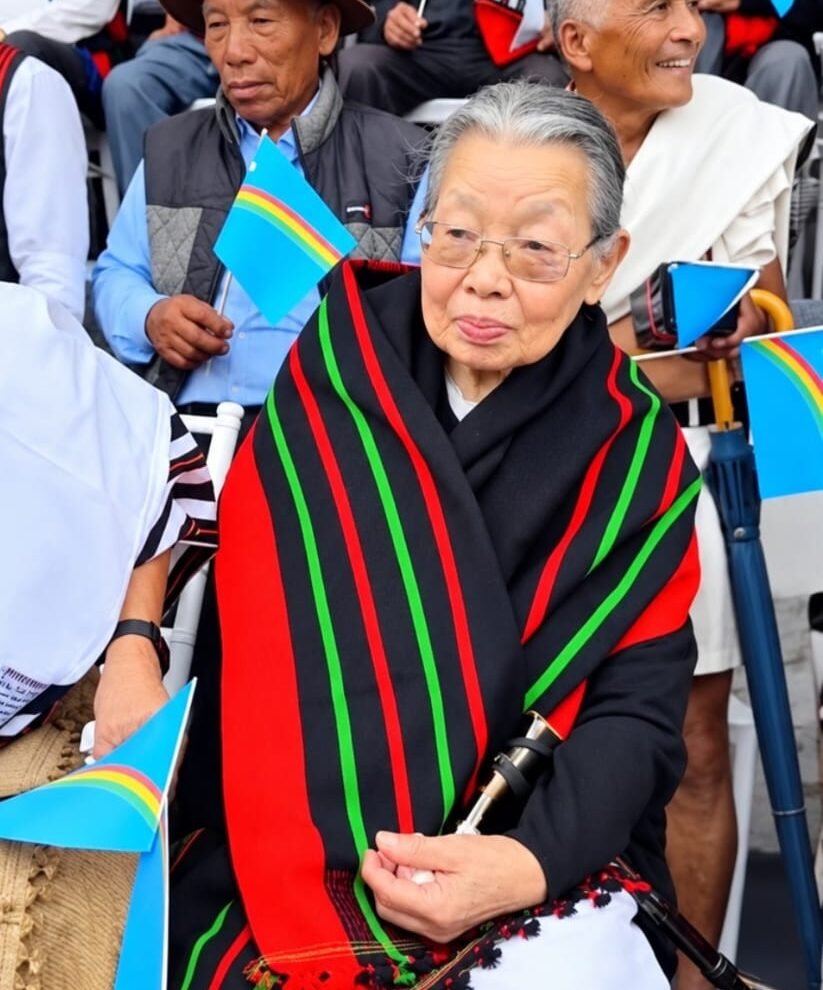
KOHIMA, October 8, 2026: Adinno Z. Phizo, President of the Naga National Council (NNC) and eldest daughter of prominent Naga nationalist leader A.Z. Phizo, passed away at Bethel Medical Centre in Kohima on Thursday, October 8, 2026. She was reportedly in her 90s. She died at around 7-9 p.m., according to information available at the time of publication.
Her death marks the end of a significant chapter in the institutional history of the NNC, where she served as one of the principal custodians of the political legacy associated with her father and the council’s historical position for more than three decades.
Adinno assumed leadership of the NNC following the death of her father, A.Z. Phizo, in London on April 30, 1990. Within hours of his death, she was appointed Acting President at the NNC office in London by senior Executive Council members Khodao Yanthan and Yongkong. She was subsequently formally elected President at a general meeting held at Kohima Village Hall on May 12, 1990.
Her leadership was reaffirmed at the NNC General Meeting held at Longmisa Village on March 14–15, 1991, where more than 6,000 Nagas reportedly attended and political plenipotentiary power was conferred on her by Zashei Huire, President of the Federal Government of Nagaland. She subsequently came to be identified with the NNC faction commonly associated with her leadership.
For decades, Adinno remained committed to the original political position of the NNC. Her public statements consistently emphasised Naga political history, national identity, unity and the right to self-determination. She repeatedly invoked the Naga Voluntary Plebiscite of May 16, 1951, which the NNC has regarded as a foundational expression of the Naga people’s political will.
The 1951 plebiscite, in which the NNC has maintained that an overwhelming majority of Nagas voted for independence, remains a contested historical and political issue, with differing interpretations regarding its conduct, legitimacy and implications.
Adinno’s political inheritance was inseparable from the legacy of A.Z. Phizo, who is widely regarded within Naga nationalist circles as a central figure in the Naga political movement. Under his leadership, the NNC pursued a political course that included the declaration of Naga independence on August 14, 1947, and the 1951 plebiscite.
The NNC itself was constituted at Wokha on February 2, 1946. Adinno continued to refer to these historical milestones throughout her tenure, presenting them as part of the Naga political journey and the foundation of the NNC’s longstanding position.
As recently as February 2026, while marking the 80th anniversary of the NNC’s formation, Adinno reiterated the organisation’s position that the Nagas constitute a distinct political and national entity with a right to sovereignty.
Her political messaging also continued to invoke the 1951 plebiscite. In public commemorative messages, she maintained that the plebiscite represented a continuing mandate of the Naga people and that the Naga political question should be addressed in accordance with that historical position.
Adinno spent several decades in London alongside her father before returning to Nagaland on significant occasions. In 1990, she accompanied the mortal remains of A.Z. Phizo from London to Nagaland following his death. Years later, she also accompanied the mortal remains of her brother, Kevilevor Phizo, back to the homeland in 2013, an event regarded as symbolically significant within the Phizo family and sections of the Naga nationalist movement.
Throughout her public life, Adinno remained closely associated with commemorations connected to Naga political history, including the death anniversary of A.Z. Phizo and Plebiscite Day observances.
Her political career unfolded during a period marked by divisions within the wider Naga nationalist movement. Following A.Z. Phizo’s death, competing factions emerged within the NNC, with Adinno’s faction continuing to uphold what it described as the original NNC position. Historical accounts record that she formally assumed the NNC presidency in 1990 and remained its leading figure thereafter.
For more than three decades, Adinno Phizo carried the political legacy of one of the Naga movement’s most influential families. Her leadership was defined by an unwavering adherence to the NNC’s historical position and by her continued insistence that Naga history, identity and political rights should remain central to any discussion of the future.
With her passing, the Naga political landscape loses a figure who represented the continuity of one of its oldest political institutions. Her legacy will remain closely intertwined with the history of the NNC, the political legacy of A.Z. Phizo and the continuing debate over Naga identity, sovereignty, unity and the future of the Naga political movement.
(source Naga Country News






 Users Today : 64
 Total Users : 98272