


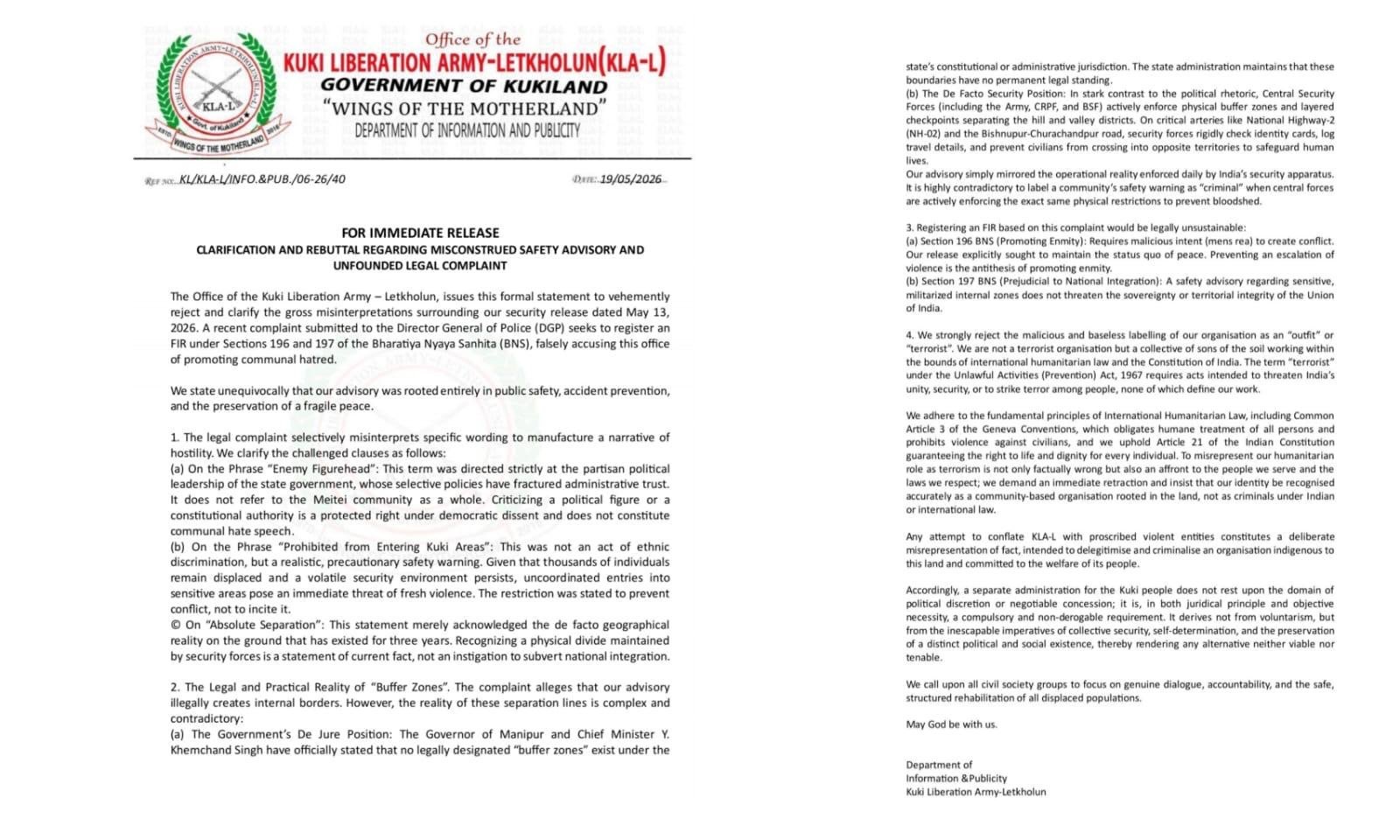
Kuki Liberation Army-Letkholun has issued a detailed clarification and rebuttal regarding allegations surrounding its recent safety advisory, strongly rejecting accusations that the organisation promoted communal hatred or threatened national integrity.
In a press release dated May 19, 2026, the organisation stated that a complaint had recently been submitted to the Director General of Police (DGP) seeking registration of an FIR under Sections 196 and 197 of the Bharatiya Nyaya Sanhita (BNS). According to the organisation, the complaint falsely accused the office of inciting communal hostility through a public advisory released on May 13, 2026.
The statement asserted that the advisory was issued purely in the interest of public safety, accident prevention, and preservation of peace amid the fragile law and order situation prevailing in the state.
Clarifying the phrases used in the advisory, the organisation stated that the term “Enemy Figurehead” was directed at the political leadership and policies of the state government and not against the Meitei community as a whole. It argued that criticism of political authorities falls within democratic rights and should not be interpreted as communal hate speech.
Regarding the advisory cautioning people against entering Kuki areas, the organisation maintained that it was not an act of ethnic discrimination but a precautionary safety measure aimed at preventing fresh violence in sensitive areas. It stated that thousands of people remain displaced and that uncoordinated movement into vulnerable zones could trigger renewed conflict.
The statement also addressed references to “absolute separation,” saying the phrase merely acknowledged the “de facto geographical reality” that has existed for the past three years due to security arrangements and ongoing ethnic tensions. It claimed that recognising physical divisions enforced by security forces does not amount to an attempt to undermine national integration.
On the issue of “buffer zones,” the organisation pointed to what it described as contradictions between the official position of the Manipur government and the operational realities enforced by central security forces. While the Governor and Chief Minister have reportedly maintained that no legally designated buffer zones exist, the organisation argued that security forces continue to enforce physical separation in hill and valley districts through checkpoints, travel verification, and movement restrictions on key routes such as National Highway-2 and the Bishnupur–Churachandpur road.
According to the statement, the advisory merely reflected these realities already being implemented by security agencies to prevent bloodshed. It further claimed that criminalising such warnings while authorities themselves maintain similar restrictions would be contradictory.
The organisation also argued that the proposed FIR would be legally unsustainable. Referring to Section 196 of the BNS, it claimed the advisory lacked malicious intent and was instead intended to maintain peace and prevent escalation of violence. It similarly rejected allegations under Section 197 relating to threats to national integration, asserting that a safety advisory concerning internal tensions does not threaten India’s sovereignty or territorial integrity.
The organisation strongly objected to being labelled as a terrorist outfit, describing itself instead as a community-based organisation rooted in the land and committed to the welfare of its people. It argued that its activities do not fall within the definition of terrorism under Indian law and stated that it adheres to principles of humanitarian law, including protections for civilians.
The statement further maintained that any attempt to equate the organisation with proscribed violent entities amounted to deliberate misrepresentation intended to delegitimise the organisation and criminalise its activities.
Reiterating its political position, the organisation stated that the demand for separate administration for the Kuki people arises from concerns related to collective security, self-determination, and preservation of political and social identity. It described the demand as a “non-negotiable necessity” rather than a political concession.
Concluding the statement, the organisation called upon civil society groups to focus on dialogue, accountability, and the safe rehabilitation of displaced communities while urging efforts toward peaceful resolution of the ongoing crisis.








 Users Today : 46
 Total Users : 66485