




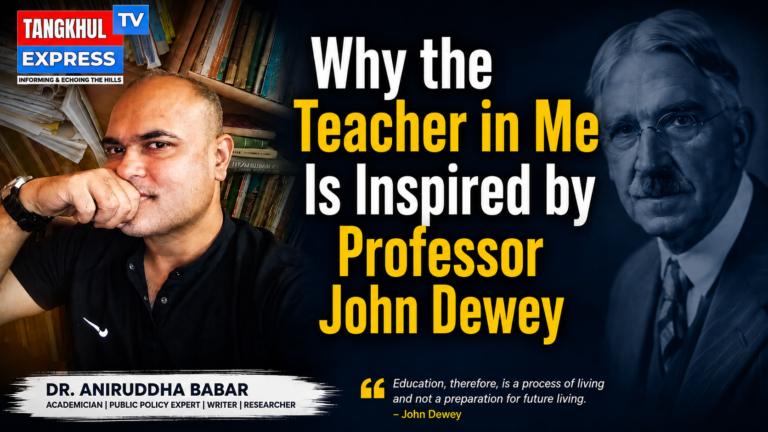
(Dr. Aniruddha Babar is a Senior Academician, Public Policy Expert & Social Development Specialist, Writer, and Researcher currently serving in the Department of Political Science, St. Joseph College, Ukhrul, Manipur. He is also the Co-Founder and Deputy Director of the Centre for North-East Development and Policy Research (CNEDPR), St. Joseph College, Manipur.)
“Be a lamp for yourselves. Be your own refuge. Seek for no other. All things must pass. Strive on diligently. Don’t give up.” ~ Siddharth Gautama “The Buddha”.
As a child, I was strangely curious about the cycle of life. I would look at people being born, growing old and eventually disappearing and wonder about the mystery hidden inside this ordinary sequence. Why are we born? Why do we die? What are we supposed to do between birth and death? The last question fascinated me most. Birth and death seemed like two fixed gates at either end of a road while the great unknown was the road itself. What are we supposed to do with the years given to us between them? Why do some people spend their lives chasing wealth, others knowledge, power, love, adventure or God? What makes one life meaningful and another empty? I had no language for these questions then and certainly no answers. I only had the curiosity. Years later, at seventeen, during my wandering days as a college student, that curiosity took the form of a rebel soul and introduced me to the pleasures of disobedience. I would sometimes leave home against my parents’ wishes carrying a small bag, a few books and just enough money to take me towards the next unknown place. I travelled because I wanted to see the world for myself, to follow roads whose destinations mattered less than the fact that they led somewhere I had never been. I wanted mountains, unfamiliar villages, railway platforms at dawn and strange faces in markets. I wanted the world before anyone could explain it to me. I did not know that somewhere along those roads I would encounter an ancient teacher whose final words would return me to the questions I had been asking as a child: Why are we here and what should we do with the brief journey between birth and death?
The teacher was the Siddharth Gautama “The Buddha” and the words that eventually reached me were spoken at the end of his own journey. They were not words delivered at the beginning of a philosophical system or during the excitement of discovery. They came when his body was exhausted, when his disciples were gathered around him and when there was almost nothing left to say. That gives them a peculiar force. A person’s final words can reveal what remained important when everything else had fallen away. In the Buddhist tradition, the Buddha’s final exhortation is preserved in the Mahāparinibbāna Sutta: “Vayadhammā saṅkhārā; appamādena sampādetha.” It is commonly translated as “Conditioned things are subject to decay; strive on with diligence.” The Pāli text explicitly identifies this as the last word of the Tathāgata.
The sentence sounds almost severe when taken by itself. In its setting, it becomes something far more intimate. An old man is dying. His disciples know that their teacher will soon disappear from their physical world. He has spent decades speaking about suffering, change, attachment, freedom and the nature of existence. At the end, he points towards the truth unfolding around them. Everything conditioned changes. The body changes. Relationships change. Circumstances change. Our minds change. The people we imagine will always be there eventually leave us. Then comes the second movement of the sentence: appamāda. Stay awake. Remain heedful. Live carefully. Practise with attention. Use the life that remains.
To understand why those words carry such weight, it helps to follow the Buddha towards his final days. According to the Mahāparinibbāna Sutta, he travelled from Pāvā towards Kusinārā after receiving a meal from Cunda, described in the text as a metalworker. The food called sukara-maddava in the Pāli account has been interpreted in several different ways and its exact identity remains uncertain, so it is better to preserve the ancient term than to present one disputed interpretation as established fact. After the meal the Buddha became seriously ill, yet continued towards Kusinārā.
Imagine that journey. An old teacher walking towards the place where he will die. His body becoming weaker as the road continues. The people around him understanding that something irreversible is approaching. There is no grand theatre in the image of an exhausted traveller continuing along a road. There is simply a human being moving towards the end of his physical strength. Before the Buddha became an image carved in stone or a name carried through centuries, he was an ageing man walking towards his final resting place.
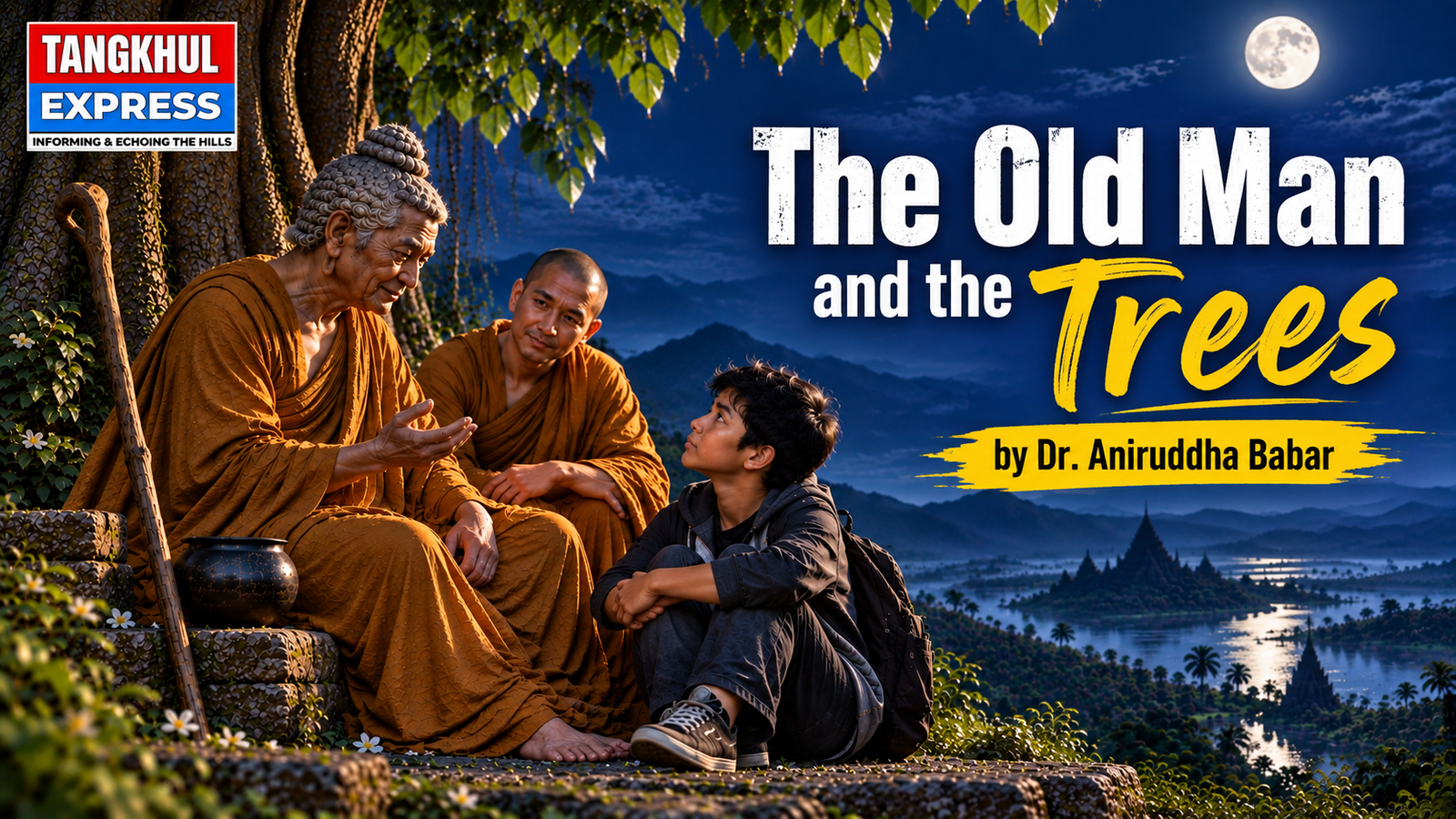
He reached Kusinārā and entered a grove of sāla trees belonging to the Mallas. There, according to the sutta, he lay down on his right side in the lion posture, with his head towards the north. The ancient account surrounds the scene with sacred imagery, including the sāla trees flowering out of season and celestial offerings. These details belong to the religious tradition preserved by the text. Beneath that imagery remains a human scene: an ageing teacher lying beneath trees while the people who love and follow him gather around him.
Imagine Kusinārā towards the end of the day. The two sāla trees stand over the Buddha as he lies on his right side. He is about eighty years old. The body that has carried him across roads, villages and forests for decades has become weak. Around him sit the monks. They have heard his voice for years. They have followed him from place to place, listened to his teachings and brought him their questions. Now they sit quietly beside him. They know that he is dying.
Ānanda is there. He has spent years close to the Buddha, seeing him in ordinary moments as well as in moments of great importance. The ancient account shows how deeply the approaching separation affects him. The Buddha reminds him of the nature of conditioned things and the inevitability of separation from everything dear.
For a moment, imagine the two of them speaking quietly beneath the trees, with the monks nearby. Ānanda has spent years listening to this voice. Now even an ordinary sentence from his teacher must sound different. He knows there will soon be a time when he will remember the voice without being able to hear it.
The Buddha had already prepared him for that moment. When Ānanda asks about what will happen to the community after the Buddha’s passing, the instruction is clear: the Dhamma (“that which upholds,” describing the natural order of the universe, cosmic law and the teachings of the Buddha) and Vinaya ( means monastic discipline, ethical conduct and the specific rules that govern the lives of monks and nuns) will serve as their teacher.
Think of the weight of that answer. For years, when there was uncertainty, there had been someone to ask. When a difficult question arose, there was a teacher sitting before them. Now that certainty is disappearing before their eyes. They will have to carry the teaching themselves.
The monks remain gathered around him. The Buddha asks whether any of them has a doubt about the Buddha, the Dhamma, the Sangha or the path he has taught. No one speaks. The ancient text records no further question.
Perhaps one monk looks towards another. Perhaps Ānanda lowers his eyes. Perhaps someone simply watches the old teacher breathing beneath the trees. These details belong to imagination because the ancient text does not record every movement or expression. Yet the human situation requires little invention. A teacher is dying. His students are sitting around him. There is nothing left to ask.
Then the Buddha speaks his final exhortation.
“Conditioned things are subject to decay; strive on with diligence.”
The Pāli account explicitly identifies these as the last words of the Tathāgata.
The sentence is simple. There is no grand farewell. He points towards something that has been true throughout his life and is now visible in his own body: everything conditioned changes.
The monks listen.
The words end.
And then there is silence.
The voice that had answered their questions for years has fallen quiet. They can still see him beneath the trees. They can still sit beside him. They can still remember his teachings. Soon there will be only memory.
According to the ancient account, the Buddha then enters successive meditative attainments before finally passing into Parinibbāna.
The monks remain there. The sāla trees stand above them. The ancient tradition describes them flowering out of season at the time of the Buddha’s passing. Whether one receives that detail as sacred tradition, religious imagery or poetry, the scene remains striking: an old teacher beneath the trees while his disciples sit around him, knowing that they are witnessing the end of his life.
Nothing can be done.
They cannot ask him to stay.
They cannot bargain with death.
They can only listen, remember and remain beside him.
Then the teacher is gone.
The grove remains.
The trees remain.
The disciples remain.
And the teaching remains with them.
Perhaps this is where the sentence begins to open up. Saṅkhārā is a rich Pāli term whose meaning depends upon context. In this teaching it points towards conditioned phenomena or formations, things that arise through conditions and therefore exist within processes of change. The idea can sound philosophical until we look at ordinary life.
Think about your own face in an old photograph. You recognise the person immediately. You also know that the face looking back at you belongs to another moment. The body has changed. The voice has changed. Interests have changed. Some relationships have disappeared. Others have deepened. Ideas that once seemed permanent have become irrelevant. A person can remain recognisably themselves while almost everything about their circumstances changes.
The same is true of the people we love. A child becomes an adult. Parents grow old. Friends move to distant cities. Lovers change. People who once occupied every corner of our lives sometimes become names in an old telephone directory. Someone can sit beside you for thirty years and then, one morning, there is an empty chair. Impermanence is present in every room of our lives.
We usually notice it most clearly when something disappears. We recognise the value of a place after leaving it. We understand the importance of a conversation after the person with whom we had it is gone. We look at an old photograph and suddenly realise that an entire world once existed inside that frame. The people were real. The laughter was real. The afternoon was real. Yet the moment cannot be recovered.
This is why impermanence can be painful. We want what we love to remain as it is. We want parents to remain healthy, friendships to remain familiar, youth to remain available and success to remain secure. The mind reaches towards permanence because permanence feels safe. Life keeps moving.
The Buddha’s insight goes further. When our sense of security depends upon things that are continually changing, fear becomes part of the arrangement. If happiness depends entirely upon keeping a particular person, position, possession, reputation or version of ourselves, every change can feel like a threat. The more tightly we hold, the more frightening change becomes.
There is another question beneath this one: who exactly is the person trying to hold everything together? Buddhism develops a distinctive analysis of the self through teachings including the five aggregates and dependent arising. The person continues through a changing process, much like a river continues while its water is constantly moving. There is continuity, yet there is no single unchanging substance that remains untouched by time.
A river can have a name, a course and a recognisable identity. Yet no single drop of water remains there forever. Human life has something of the same quality. The child I was, the seventeen-year-old who wandered with a small bag and the person writing these words are connected. They are also separated by thousands of changes.
This makes the Buddha’s final instruction more demanding than a simple reminder that death exists. Knowing that life is temporary is easy. Living with that knowledge is much harder.
We spend enormous portions of our lives behaving as though time were unlimited. We postpone conversations. We postpone journeys. We postpone reading the books we care about. We postpone telling people what they mean to us. We spend years pursuing goals that seemed urgent at twenty and strangely empty at forty. We imagine that life will begin after the next promotion, the next amount of money, the next achievement or the next major change. Meanwhile, the actual life keeps happening.
This is where appamāda becomes important. It is often translated as diligence, heedfulness, vigilance or carefulness. Its meaning carries a sense of being awake to what matters and refusing to drift carelessly through existence. Life changes whether we pay attention or not. Appamāda asks us to pay attention while it is happening.
The idea becomes remarkably relevant in the modern world. Human attention is constantly being pulled in different directions. Phones vibrate. Screens compete for our eyes. Algorithms learn what keeps us watching. One piece of information replaces another before we have had time to think about the first. We can spend an entire evening moving through hundreds of images and conversations while barely remembering any of them the following morning. Our lives are finite while the number of things demanding our attention is effectively endless.
What does diligence mean in such a world? It may mean deciding what deserves our attention before someone else decides for us. It may mean putting the phone down while another person is speaking. It may mean reading slowly, walking without headphones, sitting quietly, thinking before reacting and doing one thing properly. It may mean choosing our ambitions with some awareness of the person those ambitions are creating.
Ambition itself can be powerful. The important question is what ambition does to the person carrying it. A desire for success can produce discipline, courage and creativity. Wealth can provide freedom and security. Recognition can encourage excellence. Each can also become an endless measurement system in which every achievement creates the need for another.
The Buddha’s final sentence therefore reaches into the quality of attention with which we live. If everything changes, how carefully should we choose the things to which we give our limited time? If the body ages, what are we doing with the years when it is strong? If relationships can end, how are we treating the people sitting beside us now? If our own identity continually changes, which habits are we strengthening through repetition?
Character is built quietly in precisely this way. A moment of anger can become a habit of anger. A habit of generosity can become a disposition towards generosity. Repeated distraction can weaken attention. Repeated attention can strengthen it. Every ordinary day gives us countless opportunities to shape the person who will exist tomorrow.
This is why the Buddha’s final instruction contains both a fact and a responsibility. The fact is impermanence. The responsibility is how we live within it.
There is also something beautiful in impermanence. A sunset matters partly because it disappears. Childhood matters because it cannot be repeated. A journey becomes precious because the traveller eventually comes home. A conversation between two old friends can become unforgettable precisely because there will be fewer such conversations in the future.
Knowing that an evening will end can make us look more closely at the light. Knowing that a parent is ageing can make an ordinary conversation feel precious. Knowing that our own youth is passing can make us question what we are doing with it. Knowing that we will die can make the question of how we live impossible to postpone forever.
This does not remove grief. When someone we love dies, the knowledge that death is natural does not make the empty chair less painful. The Buddha’s teaching gives grief a place within the larger movement of existence. We suffer because we love, because we remember and because we form attachments to people and places that matter. Understanding impermanence can allow love to become more attentive because we know that every shared moment has a boundary.
Perhaps this is one reason the Buddha’s own death matters so much. He was not standing outside the human condition explaining it to everyone else. At the end, his own body became part of the teaching. The teacher who spoke about ageing became old. The teacher who spoke about illness became ill. The teacher who spoke about death approached death. The teaching and the life became inseparable.
There is a temptation to turn the Buddha into something distant and almost superhuman. The final scene brings him close. We see an ageing body. We see disciples who are going to lose someone they love. We see a teacher who has reached the edge of physical existence. We hear a final sentence. We sit with the silence that follows.
That silence matters because the Buddha’s physical journey ended while his words continued travelling. The final-words passage itself belongs to a wider history of Buddhist textual transmission. Versions of the passage appear across Pāli, Sanskrit, Chinese and Tibetan traditions with variations. This means we should be cautious about imagining that we possess a modern stenographic recording of the exact historical moment. What we can say with confidence is that the Pāli Mahāparinibbāna Sutta identifies “Vayadhammā saṅkhārā; appamādena sampādetha” as the Tathāgata’s final utterance and that the teaching became deeply established in Buddhist tradition.
The distinction between historical certainty and religious tradition does not diminish the story. It gives us a clearer way of approaching it. The text preserves a tradition. Buddhist communities memorised and recited it. Generations of monks carried it across languages and regions. Philosophers interpreted it. Artists represented the Buddha beneath the sāla trees. Ordinary people heard the sentence in temples and monasteries. The Buddha’s physical journey ended at Kusinārā. His words continued travelling.
They travelled across India and beyond. They entered different languages, cultures and intellectual worlds. Kingdoms rose and disappeared. Trade routes shifted. Languages changed. Manuscripts were copied. Monasteries flourished and declined. Modern nation states eventually appeared. Technology transformed the scale and speed of human life.
Still, the problem remained.
Everything changes.
And what are we doing with our time?
That question belongs to no single civilisation. A person in ancient India could ask it. A European reading beside a railway window could ask it. A farmer, student, parent, artist, entrepreneur or monk could ask it. A person living in a mountain village and a person living among skyscrapers can both wake one morning with the sudden awareness that the years are moving faster than expected.
The Buddhist answer begins with seeing clearly. See ageing. See death. See attachment. See desire. See the mind itself changing. See how quickly a moment disappears. Then cultivate the qualities that allow a person to live with that knowledge: attention, ethical conduct, wisdom, compassion and disciplined practice.
Within Buddhism, this path ultimately points towards liberation from the cycle of conditioned existence, towards Nibbāna. The Buddha’s final passing is traditionally called Parinibbāna, the final passing away of one who has attained Nibbāna. These are specifically Buddhist concepts belonging to a larger understanding of suffering, craving, dependent arising, liberation and rebirth.
For someone outside Buddhism, however, the final sentence can still be encountered without accepting every element of Buddhist doctrine. One can stand at the edge of the teaching and simply listen.
Everything conditioned changes.
Stay awake.
Live carefully.
Perhaps that is enough to begin.
And perhaps this is where I return to the child I once was.
I used to wonder why we are born and why we die. I imagined birth and death as two mysteries with an enormous blank space between them. The older I became, the more I realised that the blank space is the real subject of the question.
We know that we are born.
We know that we die.
The mystery is what we do in between.
At seventeen, I had little understanding of the answer. I simply believed the road would always continue, because every road seemed to lead to another. I imagined there would always be another journey, another morning, another opportunity to discover something new and begin again. Youth has its own relationship with time. It looks ahead and sees possibilities stretching into the distance.
Years gently reshape that view.
The roads remain.
The traveller grows with them.
I first encountered those final words when the future seemed enormous. The Buddha spoke them when his future, in the ordinary human sense, had almost disappeared. Between those two moments lies an entire human life.
The old teacher beneath the flowering trees had reached the end of his road. His body was failing. His disciples were gathered around him. His physical presence was about to disappear while the teaching would continue travelling across centuries.
He had almost nothing left to say.
So he said what mattered.
“Conditioned things are subject to decay; strive on with diligence.”
And then, according to the ancient account, the Buddha passed through his final meditative attainments and entered Parinibbāna.
The grove remained.
The road remained.
The world continued changing.
And the words continued travelling.
The question I carried as a child has therefore acquired a different shape with age. I once wondered why we are born and why we die. I eventually understood that every human life is enclosed between those two mysteries. The harder question is the one that lies between them:
What are we doing with the time we have been given?
Perhaps there is no single answer. Perhaps each person has to discover it through the way they live.
We work. We love. We fail. We travel. We lose people. We make mistakes. We forgive. We grow older. We change our minds. We begin again. We leave places and sometimes return to them. We carry memories of people who are no longer here. We make plans knowing, somewhere beneath the plans, that none of them comes with a guarantee.
The road moves beneath our feet whether we pay attention or not.
So perhaps the Buddha’s final words are less about death than they first appear.
Perhaps they are about being alive.
About noticing the morning before it becomes afternoon. About listening when someone we love speaks. About recognising that youth is passing while we still possess it. About asking what our ambitions are making of us. About choosing where our attention goes. About refusing to sleepwalk through a life that cannot be repeated.
Perhaps the deeper lesson of impermanence is not simply that things come to an end, but that life is continually unfolding. A morning becomes an afternoon, a child becomes an adult, a journey becomes a memory and a question slowly becomes understanding. Change keeps opening new possibilities. The road ahead may be unknown, yet it remains open. To live with awareness is to recognise that each moment is part of that unfolding and to meet it with attention, curiosity and the willingness to grow.
At seventeen, I wanted roads whose destinations I did not know. I carried a small bag, a few books and very little money. I left home sometimes against my parents’ wishes because the unknown seemed more interesting than the safety of the familiar. I thought I was simply wandering.
Perhaps I was also learning the first lesson of impermanence.
Every road ends.
Every journey changes the traveller.
And every morning gives us a little less time than the morning before.
The Buddha’s final words were spoken more than two thousand years ago beneath two sāla trees in Kusinārā. He had spent his life reminding people of impermanence. At the end, when his own body had become the final evidence of those words, he gave his disciples one last instruction: “Strive on with diligence.”
I think about that old man beneath the trees and about the seventeen-year-old who once walked away from home with a small bag, a few books and the foolish confidence that there would always be another road. I think about the child who had once looked at life and asked, Why are we born? Why do we die? What are we supposed to do between the two?
I still do not have a complete answer.
Perhaps the Buddha never intended to give one.
Perhaps he was pointing towards the question itself.
The road is temporary.
The traveller is temporary.
The people we love are temporary.
The morning is temporary.
We are temporary.
And precisely because of that, this moment matters.
So the old teacher’s final words keep travelling.
Everything conditioned changes.
Stay awake.
Strive on with diligence.
And somewhere between birth and death, on whatever road we happen to be walking, we have to decide what we will do with the time that remains.








 Users Today : 411
 Total Users : 82076