


A sharply worded statement issued by Khanuithot-Khon, “Voice of the Naga Youth,” has intensified an already volatile narrative surrounding the ongoing tensions in Manipur’s hill districts. The document presents a forceful and uncompromising perspective, alleging a calculated pattern of violence, strategic communication, and political maneuvering linked to Kuki armed elements and civil society organizations (CSOs). At its core, the statement is not merely a recounting of incidents it is an attempt to define the conflict itself.
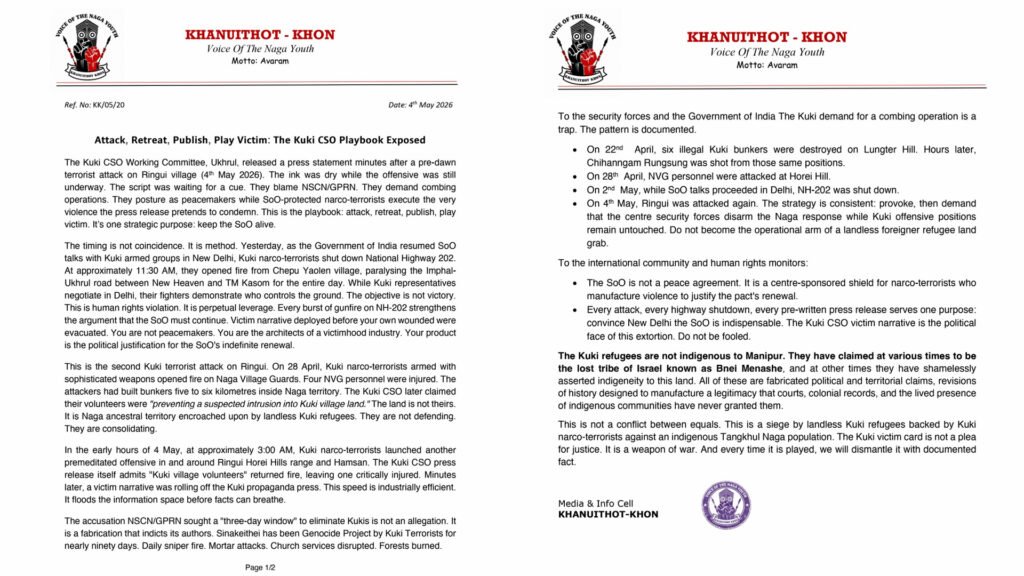
The release outlines a sequence of events between late April and early May, pointing to attacks on villages such as Ringui, confrontations involving Naga Village Guards, and disruptions along National Highway-202. According to the statement, these incidents are not isolated, but form part of a deliberate strategy: provoke violence, retreat, shape public perception through rapid media narratives, and then position as victims while calling for state intervention. This cycle, it argues, is designed to influence policy decisions particularly the continuation of the Suspension of Operations (SoO) agreement.
A central claim is that the SoO, rather than functioning as a peace mechanism, has become a shield enabling armed groups to regroup and operate with impunity. The document portrays each outbreak of violence and subsequent appeal for security action as reinforcing the argument for extending the agreement. In this framing, violence becomes both tactic and leverage.
Equally striking is the statement’s challenge to prevailing narratives about identity and indigeneity. It disputes claims made by sections of the Kuki community regarding historical roots in Manipur, describing them as politically constructed assertions aimed at legitimizing territorial claims. Such assertions are deeply contentious and reflect the broader, long-standing disputes over land, history, and recognition among communities in the region.
The tone of the statement is confrontational, particularly in its appeal to the Government of India and security forces. It warns against what it describes as being drawn into a “trap” where enforcement actions may disproportionately affect one side while leaving others untouched. This reflects a deep mistrust of both security operations and political processes, suggesting that neutrality itself is under scrutiny.
At the same time, the document calls on international observers and human rights groups to look beyond what it labels as “pre-written narratives.” It accuses sections of civil society messaging of shaping perceptions before facts are fully established, effectively controlling the information space during moments of crisis.
What emerges from this statement is not just an account of violence, but a battle over narrative dominance. Each side in the conflict is not only contesting territory but also legitimacy seeking to define who is aggressor, who is victim, and who has the rightful claim to land and history.
However, such strongly worded positions also underline a deeper challenge: the risk of narratives hardening into absolutes. When each side views the other not just as an adversary but as fundamentally illegitimate, the space for dialogue narrows sharply. The language used on all sides, can shape realities on the ground as much as the events themselves.
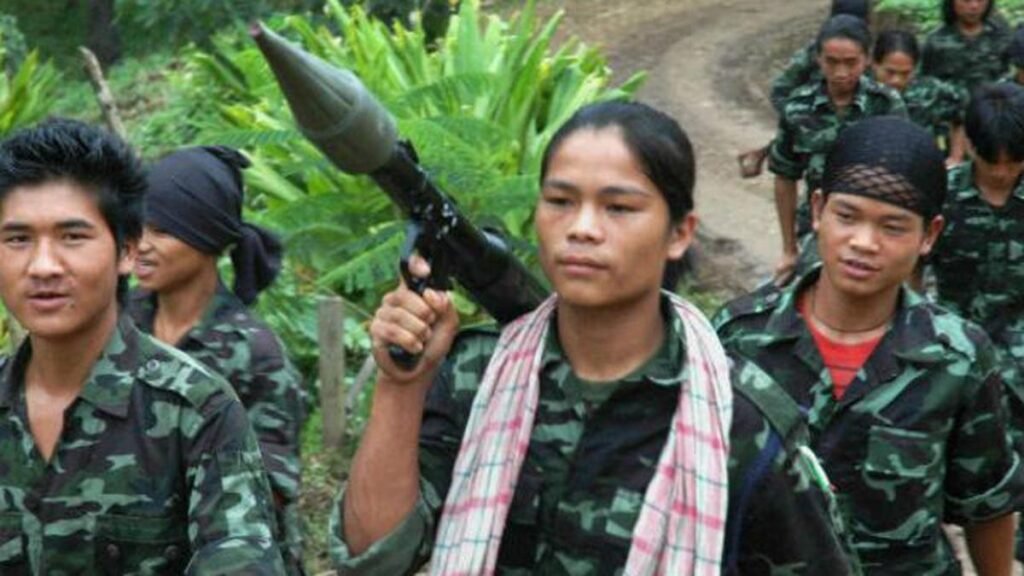
As tensions continue, the need for independently verified information, balanced reporting, and credible mediation becomes increasingly urgent. Without these, the conflict risks being driven as much by perception and rhetoric as by facts making resolution even more elusive.
This statement, while reflecting one perspective, is a reminder of how deeply layered and complex the situation in Manipur has become where every incident carries not just immediate consequences, but also feeds into a larger, contested story about identity, power, and belonging.







 Users Today : 103
 Total Users : 98311