
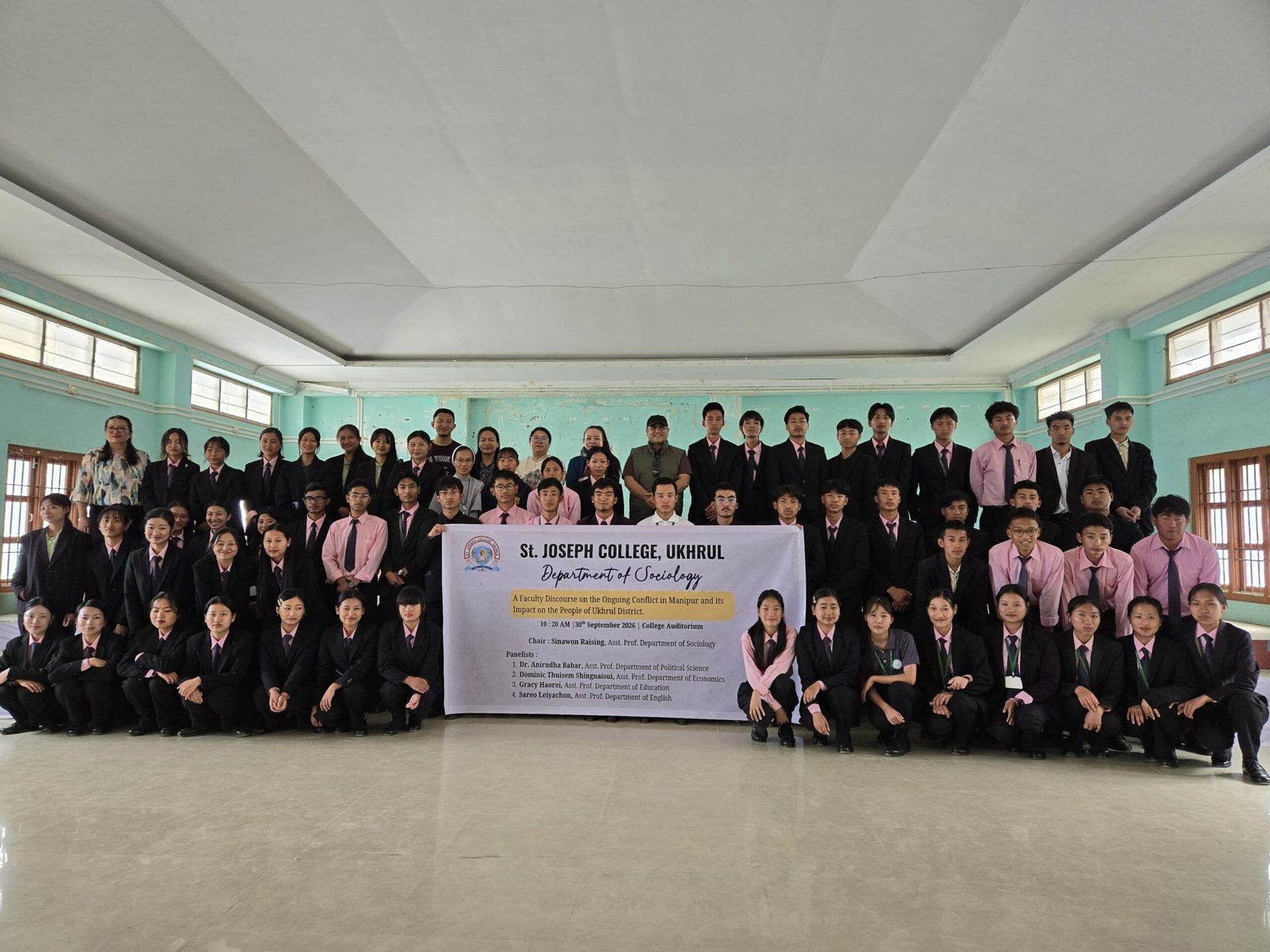
UKHRUL, September 30: The wider impact of Manipur’s prolonged conflict on governance, household economies, education, land, environment and cultural life came under discussion at St Joseph College, Ukhrul, during a faculty discourse organised by the Department of Sociology on Wednesday.
Titled “A Faculty Discourse on the Ongoing Conflict in Manipur and its Impact on the People of Ukhrul District,” the programme brought together faculty members from different academic disciplines and students from the Departments of Political Science, Sociology, Economics, English and Social Work.
The discourse was chaired by Sinawon Raising, Assistant Professor, Department of Sociology, while Yurkhanthing Shangchiri, Assistant Professor and Head of the Department of Sociology, delivered the welcome address.
Dr. Aniruddha Babar, Assistant Professor of Political Science, opened the academic presentations with “Governance in Conflict-Affected Manipur: Public Policy, State Capacity and Continuity of Essential Services.” He examined the pressure conflict places on the relationship between citizens and public institutions and stressed the need for responsive governance, confidence-building measures and continuity of essential services.
He also highlighted comparatively peaceful areas of Ukhrul, including the Ukhrul-Tusom stretch, suggesting that such pockets could be identified for development and improved connectivity even amid the continuing conflict.
Babar also drew attention to the poor condition of the Ukhrul-Tusom road, which connects towards Somra and further to Layshi in Myanmar, and questioned why an important route should remain underdeveloped.
The economic dimension of the conflict was examined by Dominic Thuisem Shingnaisui, Assistant Professor of Economics, in his presentation “Conflict and Economy.” He discussed the impact of blockades and transportation disruptions on the movement of essential commodities and the resulting pressure on household purchasing power.
Referring to disruptions experienced during 2023, Shingnaisui said the economic consequences of blockades often continue even after roads reopen, through higher prices, increased transportation costs and pressure on livelihoods.
He also raised the question of whether democratic protests could be pursued through means that do not impose additional burdens on ordinary people, while stressing that conflict recovery must ultimately contribute to sustainable development and continued delivery of public services.
The impact on education was addressed by Gracy Haorei, Assistant Professor of Education, who presented “Educational Access and Learning Conditions in Ukhrul District, Manipur.”
Haorei highlighted the disruption of students’ academic routines, insecurity caused by prolonged instability and the impact of conflict on teachers and schools. She also pointed to continuing educational challenges stemming from the 2023 violence, including uncertainty surrounding examination schedules and disruptions to the continuity of teaching and learning.
The environmental and cultural dimensions of conflict were discussed by Sareo Leiyachon, Assistant Professor of English, through her presentation “Environment and Culture During Conflict.”
She examined the consequences of displacement from homes and agricultural lands, including the effects on cultivation, land use and people’s relationship with their traditional landscapes. The discussion also considered how prolonged separation from homes, fields and familiar surroundings can affect community life and cultural practices.
Shangchiri said the faculty discourse reflected the college’s responsibility to engage academically with issues affecting the society around it.
“This faculty discourse is our service to society. We believe academic institutions have a responsibility to engage with the issues and realities affecting the communities they serve,” he said.
Lieutenant Chonchui Magdalene CS, Associate NCC Officer of the college, described the programme as an important platform for intellectual exchange, saying discussions involving academics from different disciplines could help students develop a broader understanding of the conflict and its consequences.
Students also shared their reflections on the programme. Milan Kuwar, a seventh-semester BA Political Science student, said the discussion helped him understand that the consequences of conflict extend beyond loss of life and destruction of property to areas such as the economy and education.
Another seventh-semester Political Science student, Standhope Shimray, said the programme provided a multidimensional understanding of the conflict’s political, economic, educational and environmental consequences. He also highlighted the need for students to raise concerns over educational infrastructure and developmental issues affecting their communities.
In her concluding remarks, chair Sinawon Raising said academic institutions have a responsibility to continue discussing issues affecting society and encouraged students to remain engaged with challenges confronting their communities.
The faculty discourse brought together perspectives from governance, economics, education, environment and culture, providing students and faculty with a platform to examine how prolonged conflict has affected everyday life and institutions in Ukhrul district.
Conflict’s Wider Impact on Ukhrul Examined at St Joseph College

Happy
0%

Sad
0%

Excited
0%

Angry
0%

Surprise
0%

Sleepy
0%
You May Also Like


More From Author
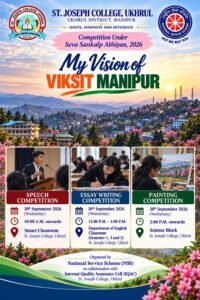
St. Joseph College Students Envision a Developed Manipur Through Seva Sankalp Competitions



 Users Today : 82
 Total Users : 98432