



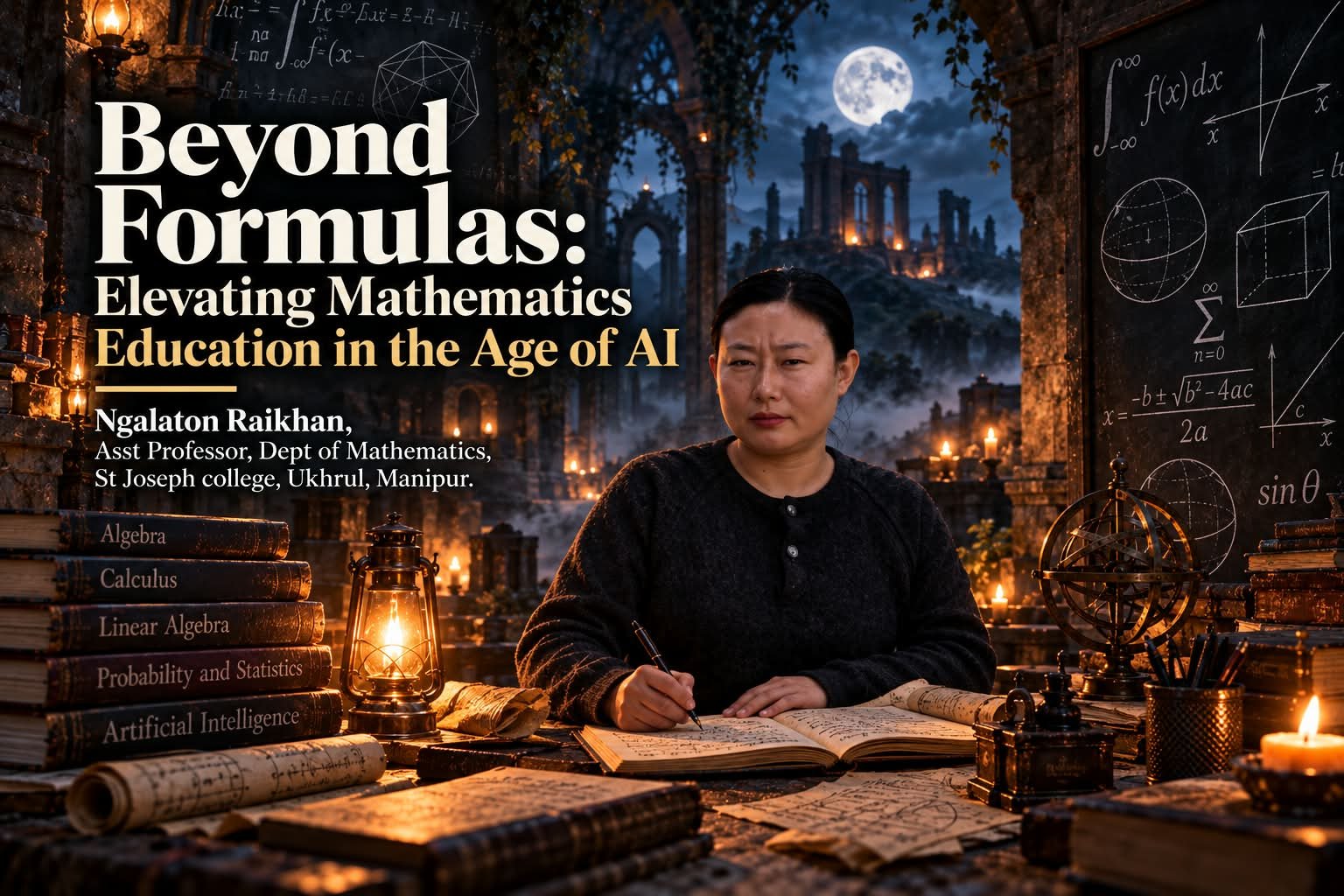
Ngalaton Raikhan, Asst Professor, Dept of Mathematics, St Joseph college, Ukhrul, Manipur.
“When machines can solve complex equations in seconds and deliver answers before the human mind has finished asking the question, humanity stands at a decisive crossroads: an extraordinary age of discovery or an era of intellectual surrender. Artificial intelligence may transform the boundaries of knowledge, but if we abandon our capacity to question, reason and think independently, we risk creating a civilisation rich in information yet impoverished in understanding. The greatest catastrophe will not be machines that learn to think, but human beings who forget how to think for themselves.”
In an age when answers are available at the touch of a screen, mathematics education faces a fundamental question: how can we ensure that students develop a genuine understanding of mathematical concepts? Smartphones, advanced calculators and artificial intelligence (AI) tools can solve complex problems within seconds. Online tutorials provide immediate access to explanations and calculation methods. These developments have expanded the resources available to learners and changed the experience of studying mathematics. Concerns remain about students’ ability to calculate independently, reason logically and understand the principles underlying mathematical solutions. Why do some students struggle with basic mathematical and aptitude problems despite having access to extensive learning resources? Answering this question requires closer attention to teaching methods, student engagement and the relationship between obtaining an answer and understanding the mathematics behind it.
There is a mystery hidden within our classrooms that rarely appears in examination results or academic reports. A student may solve a difficult problem, write down the correct answer and move on to the next question. An important question remains: does the student understand the reasoning behind the solution? This distinction can remain unnoticed for years behind marks, certificates and degrees. Its significance becomes clear when an unfamiliar problem emerges and the student must work out a solution independently. At that moment, mathematical understanding reveals its true value.
This leads to a deeper question: what does it mean to know mathematics? Genuine understanding involves knowledge of the reasoning, assumptions and relationships that make a result possible. A student who reproduces a formula demonstrates familiarity with a method. A student who can explain its derivation, identify the conditions under which it applies and use it to solve an unfamiliar problem demonstrates a deeper command of the subject. Mathematics education must cultivate the intellectual discipline required to establish why a conclusion follows, how it can be verified and where its application remains valid. These abilities become increasingly important when answers can be generated almost instantaneously by digital tools.
As mathematician George Pólya observed:
“To understand mathematics means to be able to do mathematics.”
This principle places active problem solving at the heart of mathematics education. Students develop understanding through practice, exploration, logical reasoning and the application of mathematical ideas to unfamiliar situations. The ability to explain a solution and justify each step provides evidence of a deeper engagement with the subject.
The significance of mathematical understanding extends far beyond the classroom. Mathematics provides essential foundations for many technologies shaping contemporary society. Artificial intelligence draws on linear algebra, probability, statistics and optimisation. Quantum computing relies on advanced mathematical principles. Algorithms influence finance, healthcare, industry and public administration. Mathematical literacy is important for students pursuing science, engineering, economics, commerce, political science and public policy. Strong mathematical foundations support entrepreneurship, innovation and the development of solutions to social and economic challenges. A knowledge economy depends on people who can interpret numerical information, evaluate evidence and apply analytical thinking to practical problems.
These demands place mathematics education at the centre of discussions about educational reform. The National Education Policy (NEP) 2020 emphasises conceptual understanding, critical thinking, problem solving and computational thinking. It envisages a flexible, multidisciplinary and experiential approach to learning. Digital platforms and AI powered educational tools offer opportunities for personalised instruction, interactive exercises and immediate feedback. Students can explore mathematical ideas through visual demonstrations and work through problems at their own pace. Effective implementation requires careful attention to curriculum design, teacher preparation and the development of independent reasoning. Competitive examinations also place considerable emphasis on speed and accuracy, making strong conceptual foundations essential throughout a student’s education.
Curriculum design is an important consideration in implementing NEP 2020. The restructuring of curricula and the changing place of core mathematics courses in certain higher education programmes raise questions about the depth of mathematical knowledge students receive. Multidisciplinary learning and academic flexibility require appropriate foundations in each chosen field. A strong mathematical foundation develops through sustained classroom engagement, regular practice and meaningful interaction between teachers and students. Changes to core mathematics courses should be accompanied by carefully designed alternatives that preserve the knowledge and skills required for advanced study and professional work. Academic flexibility requires sufficient subject knowledge and opportunities for intellectual development.
A practical way forward is to develop a model that combines classroom instruction with digital technology. Classroom teaching enables educators to observe how students approach problems, identify misconceptions and explain the principles underlying mathematical methods. Digital platforms can supplement this process through visual demonstrations, additional exercises, immediate feedback and explanations suited to different learning needs. Used thoughtfully, these tools allow students to practise at their own pace and help teachers address conceptual difficulties. A well designed combination of classroom instruction and digital learning can make mathematics more accessible, engaging and effective.
The implementation of these priorities requires particular attention in Manipur. The state has talented students, committed educators and considerable intellectual potential. Realising this potential requires institutional stability, adequate resources and consistent academic planning. Disruptions caused by ethnic conflict, bandhs and other interruptions have affected educational continuity in parts of the state. Uneven digital infrastructure, gaps in teacher training and uncertainty surrounding curriculum implementation can further complicate educational reform. These conditions influence the continuity of classroom instruction and the opportunities available to students for sustained mathematical practice.
Students need sufficient time to develop critical thinking and analytical skills through systematic learning. Interruptions to academic schedules can make it difficult to complete syllabi and maintain a consistent study routine. Universities need to publish their academic calendars well in advance and adhere to them as far as circumstances permit. Frequent revisions to syllabi after teaching has begun, particularly in four year undergraduate programmes, can disrupt lesson planning and place additional pressure on teachers and students. Repeated examination postponements can create uncertainty about academic progression. Examinations provide important milestones that help students organise their preparation and evaluate their progress. Consistent academic planning, transparent communication, trained teachers, accessible learning materials and coherent curricula are essential to educational quality.
Institutional continuity also influences the distribution of educational opportunities. Access to qualified teachers, reliable internet connectivity, appropriate learning materials and sustained academic guidance varies across institutions and communities. Students who receive regular classroom instruction and additional academic support may find it easier to benefit from new educational technologies. Students facing interrupted teaching schedules or limited resources may require additional support to keep pace. In Manipur, educational reform must therefore be accompanied by sustained investment in institutional capacity, teacher development and accessible learning resources. The success of NEP 2020 will depend partly on whether its opportunities reach students across the state’s diverse educational settings, including remote hill districts.
These institutional conditions shape students’ everyday experiences of mathematics. Many students perceive the subject as inherently difficult, particularly when lessons present formulas and procedures without adequate explanation of the underlying concepts. Students in both hill districts and urban areas may struggle to apply familiar methods to unfamiliar problems. When students memorise a formula without understanding its derivation, purpose or application, they may find it difficult to recognise when and how it should be used. Effective teaching must connect mathematical procedures with the concepts and reasoning that give them meaning.
Assessment practices can help strengthen this connection. Mathematical achievement is frequently measured through the number of correct answers produced within a limited period. Accuracy remains an important measure of competence, and students also need opportunities to explain their reasoning, identify patterns, compare alternative methods and assess whether an answer is sensible. Teachers can use written explanations, oral questions and unfamiliar problems to examine whether students understand the principles behind their answers. Mathematics education should equip students to solve unfamiliar problems, make connections between ideas and apply their knowledge in practical situations. These practices encourage intellectual independence and build confidence in the subject.
A curriculum that gives greater attention to application can support this objective. Students need to understand numbers, relationships, patterns and logical connections well enough to use them in different contexts. Understanding a formula involves knowing how it works, why it is valid and where it can be applied. Familiarity with shortcuts requires the ability to recognise suitable situations for their use. A complete mathematical solution involves explaining why the answer is reasonable and determining whether the method is appropriate for the problem being examined.
These principles have particular relevance to competitive examinations. Examinations conducted for recruitment and admission, including those associated with the Staff Selection Commission, banking services and UGC or CSIR National Eligibility Tests, often impose demanding time constraints. Candidates must combine accuracy with speed. Coaching institutions consequently devote considerable attention to mental arithmetic, pattern recognition and techniques designed to solve questions within a minute or less. Such methods can improve performance when students understand the mathematics behind them. A well understood shortcut can simplify calculations, save time and help candidates manage examinations effectively. Students benefit from learning the reasoning behind these methods before applying them under time pressure. Conceptual clarity enables shortcuts to become practical tools that improve efficiency and strengthen problem solving.
The growing availability of AI tools brings this question into sharper focus by making mathematical solutions accessible within seconds. Artificial intelligence can generate practice questions, explain difficult concepts through different methods, identify recurring errors and provide immediate feedback. A student struggling with algebra can request several explanations of the same problem. Teachers can use AI to prepare exercises of varying difficulty and identify areas requiring additional classroom attention. These applications can make mathematical learning more accessible and responsive to individual needs.
AI also creates opportunities to examine the reasoning behind mathematical answers. When a machine generates a solution to a quadratic equation, a student should be able to explain the steps involved, verify the roots and understand how the solution relates to the original equation. Students need to recognise when a method is appropriate and determine whether the result is mathematically sound. AI can support this process by providing alternative explanations and examples for further investigation. Its educational value grows when students use these capabilities to deepen their understanding of mathematical ideas.
This development has important implications for assessment. How can an institution determine whether a student understands a mathematical solution when the same solution can be generated by a machine? Teachers and universities need to establish whether students can explain each step, identify errors, justify their choice of method and apply the same principle to a different problem. Oral examinations, classroom demonstrations, supervised problem solving and questions requiring students to explain their reasoning can help establish the depth of their understanding. These approaches can encourage responsible use of technological assistance and strengthen the intellectual independence that mathematics education seeks to cultivate.
Students also need guidance in using AI responsibly during their everyday studies. They can attempt problems independently before examining AI generated explanations and verifying each step. They can compare alternative approaches, check assumptions and identify errors. AI systems can occasionally produce incorrect calculations or misleading explanations, making independent verification an important learning habit. Teachers can guide students in evaluating these outputs and using them to strengthen their understanding. Institutions should provide clear guidance on academic integrity so that students understand how to use AI appropriately in their studies and assignments.
These principles can be translated into practical measures within classrooms and universities. Regular problem solving sessions can require students to explain their reasoning and demonstrate how they reached an answer. Short oral assessments can help teachers identify gaps in understanding and ask students to apply familiar principles to unfamiliar situations. Professional development programmes can help educators use AI tools responsibly and assess the accuracy of their mathematical explanations. Assessment methods can combine written examinations with supervised problem solving, demonstrations and explanations of mathematical reasoning. Such measures can help institutions integrate technological assistance into teaching while keeping independent understanding at the centre of student assessment.
The broader purpose of these changes is to develop students who can interpret results, question assumptions, recognise errors and apply mathematical reasoning to real world problems. Computers and AI systems can perform calculations at extraordinary speed. Human judgement remains essential in selecting appropriate methods, interpreting findings and evaluating their significance. These abilities are increasingly relevant to financial literacy, data interpretation, scientific investigation and public decision making. In a society shaped by information and algorithms, the capacity to assess numerical information critically has become indispensable.
Mathematics education must also develop the intellectual habits required for original reasoning and proof. Mathematical intuition, proof construction and the ability to frame meaningful questions develop through sustained engagement with problems. AI can support this process by providing examples, explanations and opportunities for practice. Students need guidance in evaluating mathematical arguments, testing claims, examining evidence and understanding the limitations of the methods they use. These habits develop through practice, discussion, questioning and constructive feedback. They require students to work through challenging problems and develop confidence in their own reasoning.
Teachers play a central role in developing these abilities. Mathematics education involves guiding students through difficult concepts, encouraging persistence and building confidence in their ability to solve problems. Through classroom interaction, teachers can identify misunderstandings, adapt explanations and provide individual attention. They also encourage cooperation, intellectual honesty and respect for different approaches to problem solving. These qualities contribute to a healthy learning environment and support the wider educational development of students. AI can assist teachers with selected tasks, while professional judgement and direct engagement with learners remain essential and inevitable to meaningful education.
India’s educational future will depend partly on how effectively it implements NEP 2020 and integrates technological advancement into established teaching practices. The policy provides an opportunity to strengthen conceptual understanding, multidisciplinary learning and the practical application of knowledge. Achieving these objectives requires careful implementation, sustained investment and an education system that values academic flexibility alongside subject depth. In Manipur, this means strengthening institutional capacity, improving academic continuity and ensuring that teachers and students receive the support necessary to translate policy aspirations into classroom outcomes. Students in remote and under resourced communities must also have a fair opportunity to benefit from improvements in teaching and educational technology.
These educational priorities acquire practical meaning through the everyday work of schools and colleges, where intellectual development must ultimately translate into responsible citizenship and service to society.
At St Joseph College, Ukhrul we believe that education must cultivate intellectual curiosity, independent reasoning and the ability to apply knowledge to the challenges facing society. Mathematics develops habits of thought that extend beyond the classroom, enabling students to examine evidence, recognise patterns, make informed decisions and approach social problems with greater clarity. As artificial intelligence becomes increasingly influential in education and public life, our responsibility is to prepare students to use emerging technologies with discernment, integrity and a clear sense of social purpose. We aspire to nurture individuals who can translate knowledge into meaningful social contribution, participate thoughtfully in community development and apply their intellectual abilities to the common good. The true value of education is reflected in the understanding it develops, the judgement it cultivates and the contribution its graduates make to society.
The central question raised at the beginning of this discussion remains essential to the future of mathematics education: what does it mean for a student to understand mathematics? Success must be reflected in the ability to explain mathematical ideas, evaluate solutions and apply knowledge intelligently to strange, unknown problems. Digital technology and AI can expand access to explanations, practice and feedback. Teachers provide the guidance that helps students develop sound reasoning, intellectual confidence and responsible judgement. A strong mathematics education will prepare students to engage thoughtfully with technological change and contribute meaningfully to the society in which they live.










 Users Today : 78
 Total Users : 98660