




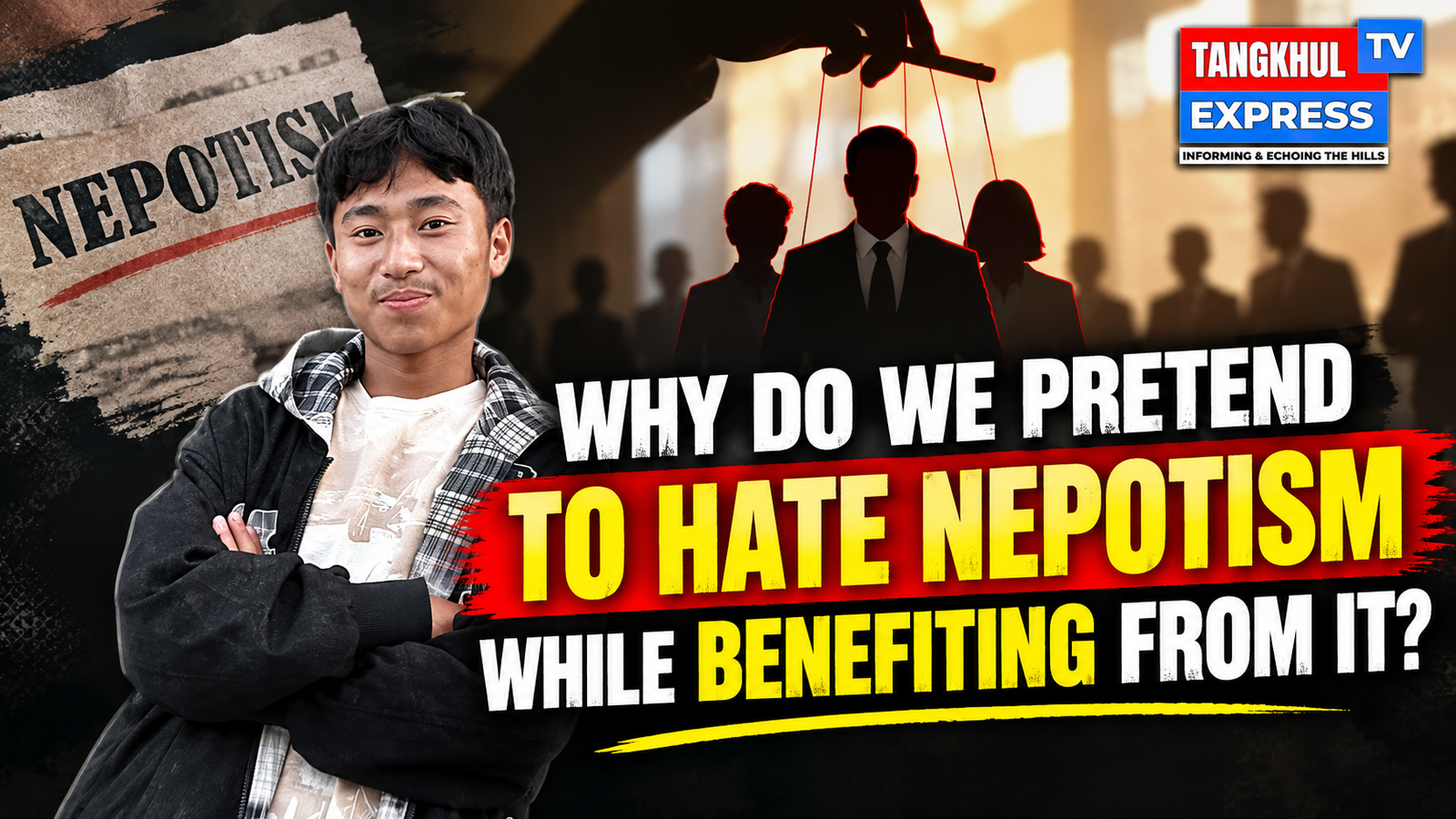
By : Chingripam Lungleng
First semester,BA Political science,St Joseph’s College,Ukhrul, Manipur.
We like to believe that we hate nepotism.
We say so whenever a star kid gets a film, a politician’s son gets a party ticket or someone’s relative walks into a coveted position with suspicious ease. The language comes quickly: merit, fairness, equal opportunity, hard work. Social media fills with outrage. Nepotism, we are told, is one of the reasons society cannot progress.
Then we put down our phones and return to our own lives.
That is where the question becomes uncomfortable.
If your father called a friend and helped you secure an internship, would you refuse it? If your uncle spoke to a professor and helped you gain admission, would you ask him to withdraw the favour? If your brother owned a company and offered you a position, would you insist that an open competition be held first?
Most people would probably accept the help.
They would thank their families. They would feel fortunate. They might even celebrate the opportunity publicly.
There is nothing inherently wrong with family members helping one another. Human beings have always relied on relationships, trust and kinship. The interesting question is what we call that help when it happens to us and what we call it when it happens to somebody else.
When our cousin forwards our résumé, it is a reference.
When a family friend makes an introduction, it is networking.
When our uncle recommends us, it is support.
When someone else receives the same advantage, we suddenly discover the word nepotism.
That contradiction deserves more attention than the usual outrage.
The comfort of being self-made
Modern society has developed a powerful admiration for the self-made person.
We like stories in which someone begins with little, works relentlessly and rises through talent and determination. Such stories are inspiring and sometimes they are true. Yet very few lives are as independent as the stories we tell about them.
Behind many successful people are parents who paid the bills, relatives who offered advice, friends who made introductions, teachers who recommended them or professional contacts who provided the first opportunity.
These forms of assistance do not necessarily cancel achievement. They simply complicate the idea of merit.
We like to say, “I earned it.”
It is harder to say, “I worked hard and I was also fortunate to have people who opened certain doors for me.”
So we often remember the effort and forget the advantages that helped turn that effort into opportunity.
The desire to appear self-made can become another form of social performance.
Family loyalty is our earliest lesson
The roots of nepotism are hardly mysterious.
From childhood, many of us are taught to look after our own. Help your brother. Support your sister. Give your children a better life. Stand by the family when somebody needs you.
These are not sinister ideas. They are among the ordinary foundations of human relationships.
The difficulty begins when the same instinct enters institutions where decisions affect people beyond the family.
A parent wanting to help a child is understandable. A family passing a business from one generation to another is also understandable.
But when professional positions, public opportunities or institutional authority are distributed primarily through family connections, the consequences extend beyond the family itself.
Nepotism can become a barrier to human compassion.
When we repeatedly reserve opportunities for people within our own circle, we can gradually lose sight of the aspirations of those outside it. The stranger competing for the same opportunity has a family too. That person may have worked just as hard, carried the same ambitions and waited just as long for a chance.
Yet we naturally feel the disappointment of our own brother, daughter or cousin more deeply than the disappointment of an unknown person.
That is where nepotism becomes more than a question of unfair advantage. It can narrow our moral vision.
This question is older than our modern debate about jobs, politics and celebrity culture.
Plato wrestled with something similar in The Republic. For the guardian class of his ideal state, he proposed abolishing the private family and raising children communally. His reasoning was that strong private attachments could make people put “my family” and “my interests” above the interests of the whole community. His solution was radical and controversial. The question behind it remains relevant: what happens when our loyalty to our own becomes so strong that we stop seeing the claims of everyone else?
Plato was not simply against family or marriage. His proposal in The Republic applied specifically to the guardian class. His later work The Laws retained private marriage and family arrangements.
The point is not that Plato had the answer.
The point is that the tension between family loyalty and wider justice is an ancient human problem.
We begin with the human instinct to care for our own and that instinct can become a habit of overlooking everyone else.
Private life can be organised around loyalty. Public institutions have to worry about competence, fairness and the wider human cost of their decisions.
The two worlds inevitably overlap. They should still be distinguished.
Talent needs an opportunity to be seen
There is another uncomfortable reality: talent does not always announce itself loudly enough to be noticed.
A society can contain thousands of capable people competing for a handful of opportunities. In such circumstances, relationships inevitably matter.
A recommendation can get a résumé read.
An introduction can secure an interview.
A trusted person can create an opportunity that an unknown applicant might never receive.
This is why networking is considered normal in professional life.
The ethical problem arises when connections become a replacement for competence.
Knowing someone is not proof of talent. Being related to someone is certainly not proof of talent.
The real question is what happens after the door is opened.
If a person receives an opportunity through a connection and then proves capable, the connection was an advantage. If the connection continues to protect incompetence, bypass standards and deny opportunities to more capable people, the issue becomes much more serious.
That distinction is often lost in the public debate.
The warning of the helping hand
There is another lesson worth remembering.
Those who give you their hand of help can also take your hand. The same hand that lifts you can destroy you.
Every favour creates a connection. Every connection can carry influence. When you repeatedly depend on someone’s help, their place in your life can grow stronger. Their expectations can grow with it.
A helping hand can secure an opportunity, make a difficult path easier or lift someone into a position. Dependence can give that same relationship influence over decisions, choices and freedom.
This is why independence matters.
Accept help when you genuinely need it. Be grateful to those who help you. Remember the value of their kindness. Build your own strength at the same time. Learn to carry your own weight.
A person who depends entirely on another person’s influence can eventually surrender more than they intended to surrender.
The warning is simple:
Be careful about the hands you hold.
A hand can lift you. A hand can hold you. A hand can pull you down.
The same hand that helped you rise can destroy you.
The dignity of standing on your own feet
There is also something deeper at stake here: dignity.
A real man or woman is someone who can stand on their own two feet, with a straight spine and an upright chin. It is someone who does not build an identity around a powerful surname, family connection, inherited influence or somebody else’s ability to open doors.
There is strength in knowing that you can carry your own weight.
Human beings need one another. We receive encouragement, advice, opportunities and kindness from others at different points in life.
The real measure of independence comes with the ability to stand without permanent dependence.
There is pride in earning your place. There is freedom in knowing that your future does not depend entirely on whom you know.
You may receive help from your family and remain grateful for it. You may benefit from a connection and acknowledge it honestly. What matters is whether you eventually become capable of standing without those supports.
That is a more meaningful idea of being self-made.
Being self-made does not mean that nobody ever helped you.
It means that you eventually learned to carry yourself.
Those who learn to rise on their own feet eventually discover that they can face the world on their own terms.
Those who rise alone will win the world.
Social media rewards moral certainty
Social media has made the contradiction even more visible.
We are constantly encouraged to announce what we believe. We condemn corruption, inequality, privilege and nepotism in carefully worded posts. We receive approval for taking the morally correct position.
Yet real life is much messier.
The same person who complains about a privileged appointment may be grateful when a relative makes a phone call on their behalf.
The same person who celebrates meritocracy may ask a family friend for an introduction.
There is a simple reason for this.
Principles are easiest to defend when they cost us nothing.
The real test comes when a principle stands between us and an opportunity we badly want.
That is where moral language becomes less comfortable.
The hypocrisy is worth examining
Nepotism itself is not the only issue. Our selective outrage is another.
We sometimes object less to unfair advantage than to somebody else possessing it.
When the advantage is ours, we see the human relationship behind it.
When it belongs to another person, we see the injustice.
That is a very human weakness.
It does not mean every criticism of nepotism is hypocritical. There are genuine forms of nepotism that damage institutions, destroy trust and keep capable people outside systems they deserve to enter.
Nor does accepting help from family automatically make someone a beneficiary of unethical nepotism.
The important question is whether we are willing to apply the same standard to ourselves that we apply to others.
If we believe that every position should be earned through merit, are we prepared to examine the advantages provided by our own connections?
If we believe that family support is a legitimate part of life, can we acknowledge that others may also have received such support without immediately assuming that they are undeserving?
These questions take us beyond the easy language of outrage.
The harder kind of honesty
We do not have to pretend that successful people emerged from nowhere.
Someone can say, “My family helped me.”
Someone can acknowledge, “A relative gave me my first opportunity.”
Someone can admit, “I benefited from knowing the right people.”
None of those admissions erase hard work.
They simply make the story more honest.
The deeper problem begins when privilege is disguised as pure merit and then used as evidence that everyone else simply needs to work harder.
That is where society starts confusing opportunity with ability.
Perhaps the most honest position is therefore a modest one: family support is natural, relationships matter, connections will always influence human affairs and institutions still need safeguards against favouritism.
We cannot eliminate every advantage that comes through family.
We can, however, decide how much advantage should be allowed to determine who gets opportunities.
And we can begin by being honest about our own behaviour.
Because it is remarkably easy to demand a perfectly level playing field while standing on a ladder somebody else placed beneath our feet.
We like the ladder when it is carrying us upward.
We become suspicious of it when someone else climbs faster.
Maybe that is why our arguments about nepotism so often go in circles.
Sometimes we are defending merit.
Sometimes we are defending fairness.
And sometimes, if we are honest enough to admit it, we are simply disappointed that the door opened for someone else.
The real challenge is not merely to condemn nepotism when we see it.
It is to recognise the privileges we accept without question, understand where they come from and decide where personal relationships should end and public fairness should begin.
Because the deepest cost of nepotism may not be that one person gets an opportunity another person deserved.
It may be that, over time, we become less capable of seeing the person who lost that opportunity as fully human.
And perhaps that is the part of nepotism we should fear most.
Not simply the unfairness it creates but the narrowness of heart it can teach us.
A society becomes stronger when people learn to stand on their own feet, carry their own weight and recognise the humanity of those standing beside them.
A straight spine is more than a posture.
It is a way of living.
The strongest person is not the one with the most powerful family behind them.
It is the one who can walk into the world without needing anyone to announce their importance.
Stand straight. Carry your own weight. Earn your place.
Rise on your own feet.
Those who rise alone will win the world.









 Users Today : 168
 Total Users : 82329